Virtual vs. Human: Why Brands are Pulling Back from AI-Only Influencers in Favor of Hybrid Collaborations
Virtual vs. Human: Why Brands are Pulling Back from AI-Only Influencers in Favor of Hybrid Collaborations
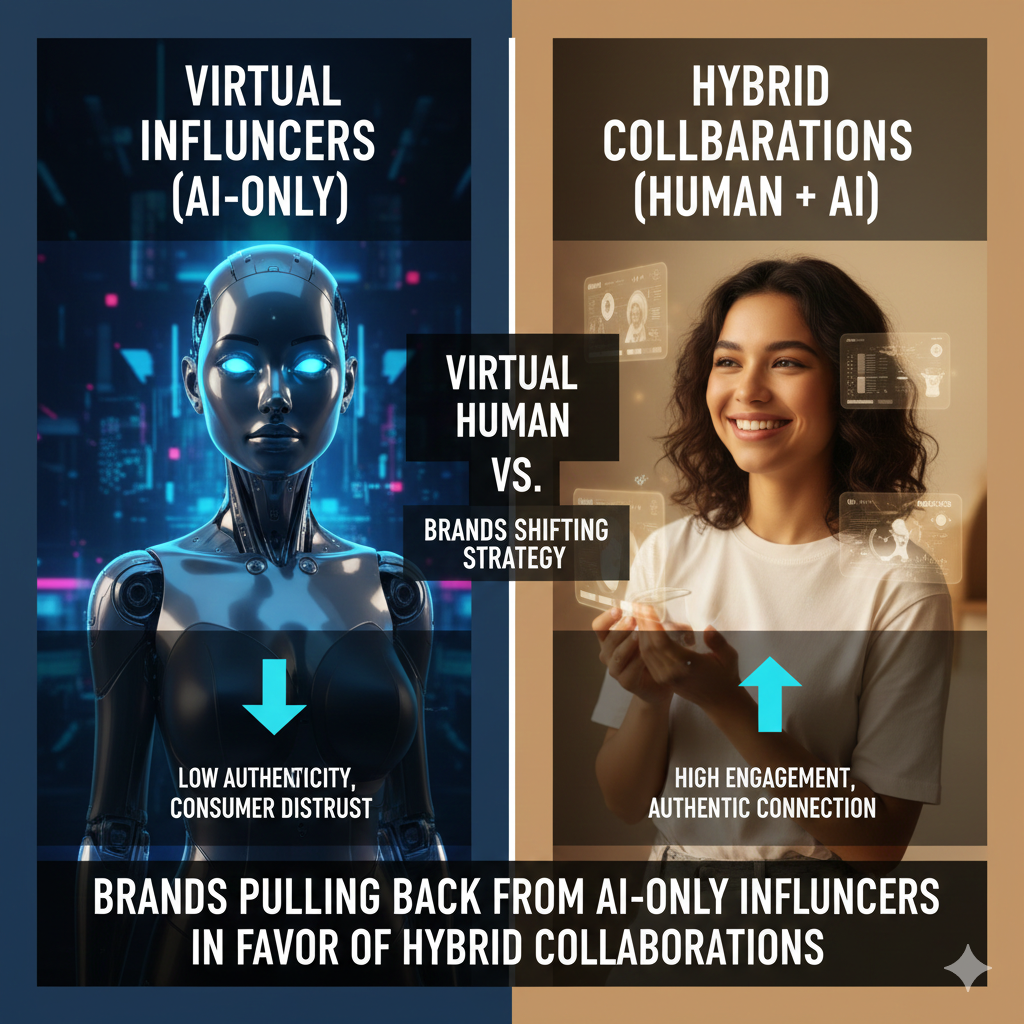
The promise of boundless creativity, flawless branding alignment, and total control over message was originally made by influencers produced by artificial intelligence. Beginning with the first advertisements, the novelty of digital-only characters with polished looks and consistent behavior was brought to the forefront. Audiences, on the other hand, rapidly became aware of the absence of true human complexity, emotional relatability, and sincerity. The level of engagement reached a plateau, and it was challenging to create trust. Companies came to the realization that artificial intelligence-only influencers, despite their technological prowess, often fail to inspire long-term devotion. As a consequence of this, the sector is moving toward hybrid partnerships, which include human authenticity in conjunction with artificial intelligence enhancement. It is possible to achieve both scalability and emotional resonance with this method, which strikes a balance between efficiency and connection to the actual world.
Why Influencers Who Only Use AI Failed to Succeed
When it comes to predictability and visual perfection, AI-only influencers are exceptional, but they suffer when it comes to genuine human connection. Whether it be via tone, comedy, or emotional reaction, audiences are able to pick up on small signs of inauthenticity. In real time, these artificial identities are unable to adjust to the nuances of social interaction. It’s possible that curiosity may initially cause engagement numbers to jump, but interest is seldom maintained over time. Due to the fact that AI does not have any life experience, emotional resonance is restricted. There is a growing trend among followers to place a higher importance on relatability and vulnerability, which are characteristics that digital personas cannot credibly imitate. As a consequence of this, novelty wears off, and the return on investment decreases over the course of time.
The Growing Popularity of Hybrid Partnerships
The purpose of hybrid collaborations is to improve innovation, production efficiency, and reach by combining human influences with artificial intelligence capabilities. AI adds enhanced graphics, data-driven insights, or content scalability, while human influencers give relatability, narrative, and emotional depth. Human influencers also provide emotional depth. Hybrid techniques are increasingly seen by brands as the optimal strategy for marketing initiatives. The use of artificial intelligence allows them to preserve genuine human connections while simultaneously lowering costs, accelerating production, and improving engagement. The drawbacks of campaigns that are only based on artificial intelligence or solely on human labor are addressed by this balancing. Both trust and operational efficiency are maximized via the use of hybrid models.
Why Authenticity among Humans Continues to Win
A level of authenticity that cannot be replicated by algorithms is provided by human influencers. Emotions are experienced by real people, choices are made on the spur of the moment, and viewers like hearing human tales that relate with them. Relatability is created via the use of humor, vulnerability, and imperfection. Because they are based on their own experiences, followers are able to sympathize with a human being. Because of this emotional connection, engagement, loyalty, and advocacy are all driven. Even when supplemented by graphics or analytics created by artificial intelligence, the human element continues to be irreplaceable. When it comes to the effectiveness of a campaign, brands are aware that audience trust and emotional connection are essential components.
How Artificial Intelligence Contributes to Human Creativity
However, AI does not replace human influencers; rather, it complements their efforts. The software has the capability to produce several variants of material, provide suggestions for captions, optimize publishing schedules, and create visual effects. The process of producing material is sped up and repetitive work is reduced as a result. More flexibility is given to creators, allowing them to concentrate on strategy, storyline, and audience participation. Instead of acting as a stand-in, artificial intelligence functions as a co-creator. Humans are able to increase their effect while yet keeping their originality via hybrid cooperation. The increased productivity and enhanced quality of the products are beneficial to brands.
The Disparity in Engagement Between Artificial Intelligence and Humans
When it comes to meaningful interaction, studies and campaign data show that content that is led by humans regularly performs better than material that is simply managed by AI. When actual individuals are engaged, there is a greater likelihood of comments, shares, and negative emotional responses. A connection with individuals that they can identify with is something that audiences seek. There is a possibility that AI-only influencers may bring about impressions; yet, these impressions often lack emotional depth. It is less probable that followers will act on suggestions if there is no human relatability that is there. Increasingly, companies are coming to the realization that impressions on their own do not promote conversion, loyalty, or advocacy.
Considerations Regarding Cost versus Value
In spite of the fact that they are less expensive and easier to manage, AI influencers provide less value over the long run. Even at higher costs, human influencers are able to generate audiences that remain engaged over time and retain their following. Hybrid partnerships provide the advantages of both worlds: lower production costs accomplished with the aid of artificial intelligence and high-value emotional connection achieved via the presence of humans. Return on investment (ROI) is today measured not just in terms of reach, but also in terms of genuine connection, trust, and conversion. There is a need to strike a balance between the value of genuine impact and the cost efficiency.
The Effects of Hybrid Campaigns on the Storytelling Process
When it comes to influencer effect, storytelling is essential. It is possible for artists to produce tales that are more immersive and richer when they collaborate with AI. Humans are able to transmit emotion, context, and personality, while artificial intelligence is capable of handling complicated visual sequences, animation, or data visualization. Because of this mix, the material that is produced is not only visually remarkable but also emotionally appealing. As a result of viewers feeling engaged, campaigns have a longer lasting impact. It is the hybrid model’s responsibility to guarantee that technology does not replace story but rather complements it.
Reputation of the Brand and Ethical Considerations Involved
There are potential ethical and reputational issues that might arise from relying only on AI influencers. There is a possibility that audiences may see the brand as not being personable, manipulative, or distant. When people work together, it demonstrates openness, empathy, and responsibility from them. The use of hybrid techniques demonstrates that businesses place a high emphasis on genuine human involvement while yet welcoming innovation. This equilibrium helps to maintain the integrity of the brand and boosts its reputation. More and more consumers are evaluating organizations based on how ethically they utilize technology and how committed they are to true connection.
Why Influencer Marketing Is the Way of the Future
Hybrid influencer models, in which human ingenuity is increased rather than replaced by artificial intelligence, are favorable for the future. Even though brands will continue to experiment with AI technologies, human presence will continue to be the most important factor in establishing emotional resonance and trust. The role of artificial intelligence will be to boost productivity and creativity, while people will be responsible for providing context, personality, and relatability. Not only will campaigns be judged based on their magnitude, but also on the depth of their connections. The partnership between humans and artificial intelligence has become the standard for authenticity, engagement, and long-term brand impact in this new era.