Fixed Payment Schedules: Why the Creator Economy is Finally Adopting Professional Payroll Standards
Fixed Payment Schedules: Why the Creator Economy is Finally Adopting Professional Payroll Standards
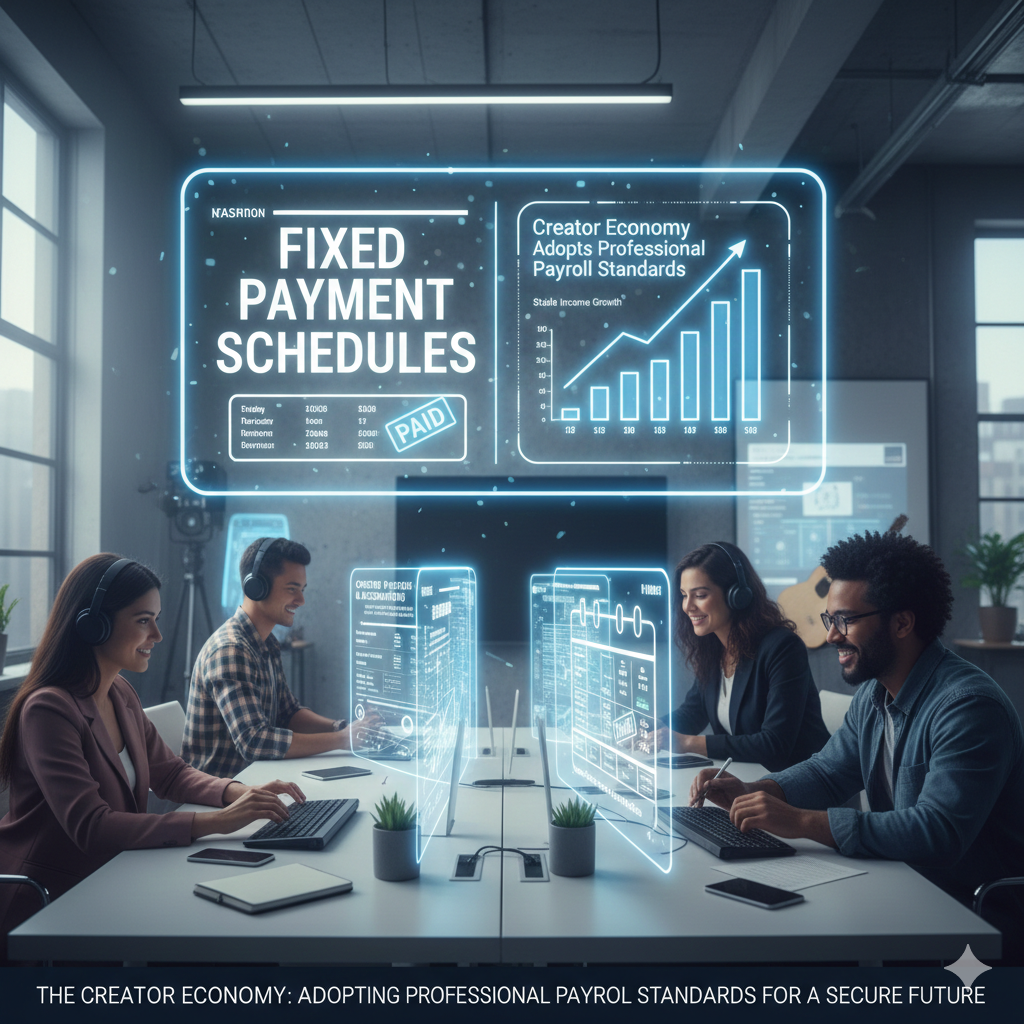
Over the course of many years, the creator economy was characterized by unpredictability in terms of revenue, delays in payments, and fluctuations in cash flow. The length of time it took for creators to get payment was sometimes weeks or even months, depending on the brand arrangements, platform regulations, or audience behavior. This gave the impression that digital work was unreliable, even for those who were successful. This lack of financial framework ended up being a significant issue as the sector progressed and evolved. As time went on, more and more artists started approaching their work as legitimate enterprises rather than as side projects. The desire for stability rose as the stakes became bigger and as the dependence on digital revenue went from part-time to full-time. This turmoil is being addressed by the emergence of fixed payment schedules as a potential solution. A gradual transition is taking place in the creative economy, moving away from informal compensation and toward professional payroll norms.
What’s the Problem with Unpredictable Income for Creators?
Unpredictable revenue has long been one of the most significant drawbacks associated with the job of creators. Campaigns, algorithms, and engagement metrics all play a role in determining your payments. It’s possible that one month can be incredibly successful, while the next month will be completely devoid of any profits. As a result, financial planning is almost difficult to do. Budgeting, savings, and making long-term investments are all very difficult tasks for creators. Uncertainty is a source of stress for even very successful innovators. Unlike traditional workers, creators are subject to financial instability, while traditional workers get incomes that are predictable. Career sustainability is hindered as a result of this unpredictability. Uncertainty about one’s income makes digital work seem to be precarious and vulnerable.
Why It Is Important for Creators to Have Financial Stability
In order to recognize content production as a legitimate job, it is necessary to have a stable financial situation. The makers will be able to properly organize their life once their revenue becomes more predictable. They have the ability to grow operations, outsource tasks, and invest in larger pieces of equipment. Both mental stress and burnout may be mitigated by stability. In addition to this, it enables artists to think about the long term rather than chasing after short-term trends. When they get consistent rewards, artists behave more like business owners than independent contractors. Their concentration shifts from surviving to growing as a result. The transformation of creativity into a viable professional path is facilitated by stability.
The Transition from Freelance Work to Professional Professions
Initially, the creator economy was a system that was built on gig deals. The creators worked on a variety of projects and deals simultaneously. No structure, no contracts, and no assurances were present in the situation. At this time, a significant number of creators are progressing toward long-term collaborations and retainers. This is very similar to conventional employment models. Instead of offering one-time bargains, brands choose to offer monthly payments. By introducing subscription and revenue-sharing arrangements, platforms are established. At this point in time, creators are no longer considered throwaway marketers. They are transitioning into career paths in the digital industry. As time goes on, the gig economy is gradually evolving into a more organized labor market.
Why Fixed Payment Schedules Have an Effect on the Behavior of Creators
The psychological approach that artists take to their job is altered by fixed remuneration. They are not interested in pursuing viral popularity but rather in maintaining stability and quality. In the absence of financial concerns, they are free to explore artistically. Regular income enables more effective management of one’s time. Those who create cease their excessive labor and begin constructing systems. They do not think in terms of desperation but rather in terms of content strategy. This therefore results in production that is more sustainable. As time goes on, the connection between the artist and the work grows more robust. The capacity to be stable is beneficial to both productivity and creativity.
Reasons Why Structured Payment Models Are Favored by Brands
It is also beneficial for brands to have predetermined payment periods. Long-term partnership and production that is predictable are provided to them. They develop continuing ties rather than constantly negotiating new arrangements with each new transaction. Time is saved, and the complexity of operations is reduced as a result. Creators are included into the overall strategy of the company. As time passes, it becomes less difficult to evaluate performance. Additionally, structured payments serve to establish trust and loyalty. The transition from transactional marketing to relationship models is being made by brands. Influencer marketing is therefore transformed into genuine commercial partnerships as a result of this.
A Look at the Functions of Retainers and Contracts
When it comes to the creative economy, contracts and retainers are becoming more popular. The legal and financial framework is brought about by these instruments. In return for constant productivity, retainers guarantee a monthly salary, which is a benefit. All of the expectations, timeframes, and obligations are outlined in the contract. The artists and the brands are both protected by this. Disagreements and misunderstandings are reduced as a result. The creators are able to feel secure, while the brands are able to feel safe. Informal cooperation is transformed into professional work by the use of legal structure. There is a growing similarity between the creative economy and conventional businesses.
All the way from Payouts on Platforms to Payroll Systems
In the beginning, the revenue of creators was mainly dependent on platform rewards. The results of these were unexpected and relied on the algorithm. Currently, artists are diversifying their revenue streams by taking use of direct customers, communities, and subscriptions. This enables enhanced control over the flow of funds. Some producers even use their own earnings to pay themselves a monthly salary using their own contributions. They function similarly to smaller businesses. There has been a significant psychological change. As soon as creators stop waiting to be compensated, they begin handling payroll immediately. They end up being their own private employers.
The Effects on Mental Health and Emotional Exhaustion
A persistent state of worry is caused by unstable income. Each and every day, creators are under pressure to perform. They are concerned about simultaneously losing importance and revenue. The psychological burden is lessened by the use of fixed payments. If a creator’s revenue is consistent, they will feel more comfortable taking pauses. They are able to make a healthy balance between their job and personal lives. As a result of the fact that survival is no longer the primary objective, burnout falls. When one’s financial situation is predictable, their emotional health improves. Creativity may be sustained rather than exhausted when there is stability in the environment.
Why the Creator Economy Is Beginning to Develop
Mature behavior is shown by the implementation of payroll norms. It is no longer possible to experiment with the creator economy. It is evolving into a genuine industry with established standards of conduct. Institutionalization may be identified by consistent payments, long-term collaborations, and contractual obligations. As a result, creators are no longer considered to be hobbyists. They are acknowledged within the workforce. Because of this, society’s perspective on digital work shifts. There is a transition occurring in the creative economy from unstructured expansion to structured sustainability. It shifts from systems that are focused on attention to those that are based on careers.
Regarding the Prospects of Creator Payroll
A greater number of standardized payment methods are anticipated to be introduced in the future. A monthly pay that is comparable to that of standard wages will be provided to creators. It’s possible that platforms will have payroll features integrated right in. Partnerships in the form of subscriptions will be adopted by brands. The use of financial planning tools will become more widespread in the workflows of creators. The acknowledgment of digital work will increase both legally and economically. There will be a shift away from the creator economy being an exception and toward it being a typical career path. In the next phase of digital labor, fixed payment schedules are not merely a feature; rather, they constitute the basis for their implementation.