The Global Age Assurance Mandate: How France and Australia’s 2026 Laws are Forcing ID Checks on Social Media
The Global Age Assurance Mandate: How France and Australia’s 2026 Laws are Forcing ID Checks on Social Media
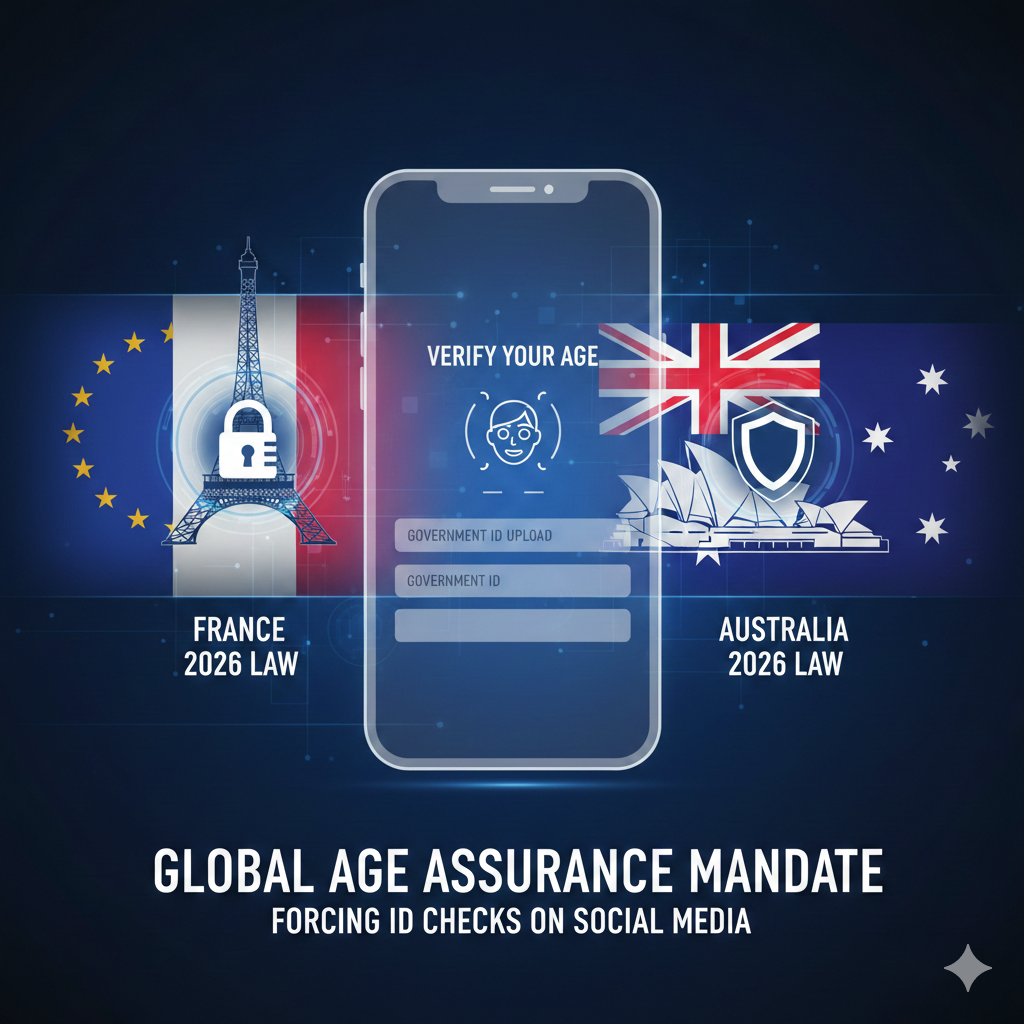
The year 2026 saw the introduction of comprehensive age assurance legislation in France and Australia. These laws mandate that social media firms must check the ages of their users before granted access to digital material. A substantial legal change in the regulation of social media platforms throughout the world has been marked by the implementation of these rules, which are intended to safeguard children from inappropriate material, online harassment, and privacy issues. The implementation of identity verification methods is increasingly required of platforms. These processes may range from checks of government-issued identification to secure digital age verification technologies. Laws that place an emphasis on responsibility, safety, and compliance force technology businesses to strike a balance between protecting user privacy and adhering to regulatory requirements. This results in more secure digital environments for consumers, but also presents platforms with operational issues and the possibility of friction throughout the process of onboarding new users. These laws are indicative of a developing worldwide trend in which governments are actively shaping digital safety via the implementation of age assurance that is legally enforced.
Why governments are requiring that individuals verify their ages
Legislation in France and Australia is a response to growing worries over the safety of children and adolescents when they are using the internet. According to studies, children and adolescents are often exposed to hazardous information, targeted advertising, and predatory conduct. There is a debate among lawmakers on whether or not social media businesses have a duty to proactively reduce these hazards. The use of content limitations, parental controls, and safety measures is made more efficient with the use of age verification. Additionally, the law reflects a greater public need for responsibility in digital domains. It is no longer sufficient for governments to depend on voluntary business activities; rather, they are developing policies that are legally enforced in order to safeguard underage consumers. Social media firms are now subject to more scrutiny, and there are legal repercussions for those that do not comply with regulations.
The Procedures That Will Be Followed When Conducting ID Checks
Platforms are expected to develop trustworthy ways for verifying users’ ages. Scanning identification issued by the government, using secure digital identification systems, or using age verification services provided by a third party are all options. In order to verify the individual’s age, the method must not needlessly reveal sensitive personal information. Encryption, anonymization, and temporary verification tokens are among options that platforms are investigating in order to protect users’ privacy. There is a possibility that users may encounter extra processes while creating an account or gaining access to certain functionalities. Another responsibility that falls on platforms is the upkeep of verification records and the demonstration of compliance to regulatory bodies. This change in both technology and operations has an impact on the user experience as well as the design of the platform.
The Consequences for the Privacy of Users
Because platforms handle sensitive personal information, age verification raises the possibility of privacy problems about the platform. In order to comply with regulations, effective data security, low data retention, and stringent access control are required. Users need to be reassured by businesses that their identification data will not be used for marketing or profiling purposes. The use of technologies that protect privacy, such as zero-knowledge proofs or secure hash verification, is becoming more popular as a means of confirming an individual’s age without necessarily disclosing all of their personal information. It is essential for adoption to find a middle ground between complying with regulations and gaining the confidence of users. When sensitive data is mismanaged, it has the potential to weaken public trust and generate various legal problems.
influence on the expansion of the platform and onboarding
User registration and participation might be slowed down if mandatory age checks are implemented. It is possible for new users to be discouraged by friction in the registration process, especially among younger demographics. Verification procedures need to be optimized by platforms in order to decrease drop-offs while also maintaining legal compliance. Cross-border activities, in which legislation vary from nation to country, may also provide additional hurdles for businesses. It is more difficult and expensive to adapt to numerous compliance requirements, which increases operational complexity. Regardless of these obstacles, platforms acknowledge that long-term safety measures are necessary for achieving sustainable development and maintaining the reputation of their brand.
The Development of Content Moderation Practices
The tactics that are used to moderate material are directly influenced by age assurance legislation. Platforms now have the ability to more consistently enforce age-appropriate filters, which allows them to adjust content exposure based on verified consumer profiles. For the purpose of preventing minors from accessing restricted content, automated systems, detection powered by artificial intelligence, and human moderation will function in conjunction with age verification. In addition to improving compliance with regulations, this strategy also helps to establish trust with parents, educators, and the general public. When moderation is made more exact and can be legally defended, it results in the creation of digital environments that are safer for audiences who are vulnerable.
The Effects of Global Ripples
It is possible that the mandates handed down by France and Australia will have an impact on law in other places. Policiesmakers in Europe, North America, and Asia are paying particular attention to the results of the implementation activities. For the sake of ensuring compliance and maintaining operational consistency, international platforms may go ahead and implement age verification everywhere. It is possible that this may hasten the implementation of uniform age verification protocols, digital identification infrastructure, and verification techniques that are sensitive to privacy all over the globe. Platforms for social media may take preventative measures to be ready for more comprehensive regulatory frameworks in order to avoid causing disruption in numerous areas.
Social media companies face a number of challenges.
The process of implementing age assurance is both technically difficult and expensive. The integration of verification tools, the maintenance of data security, and the real-time assurance of legal compliance are all requirements for platforms. Incorrect actions may result in monetary penalties, harm to one’s reputation, or legal responsibility. In addition, businesses are obligated to handle the irritation of users and support requests that are associated with verification procedures. Maintaining a healthy equilibrium between usability, accessibility, and safety is an ongoing problem. In order to successfully traverse these legal obligations, organizations are making investments in technology, policy frameworks, and user education.
Towards a Future of Secure Online Environments
A turning point in terms of online safety and digital accountability is the implementation of legislation that verify a person’s age. Identification checks are being enforced by authorities in an effort to safeguard children while also fostering responsibility across all platforms. It is possible that these measures will spread around the world, which will have an impact on the architecture of platforms, regulations regarding moderation, and privacy initiatives. Businesses who take the initiative to implement age verification will quickly establish themselves as industry leaders in the provision of secure and responsible digital experiences. By redefining what it means to run social media in a responsible manner in the current age, the regulations bring to light the rising convergence of technology, politics, and ethics.
Taking into Account Strategic Considerations for Users and Businesses
There are operational and legal ramifications that must be prepared for by platforms, artists, and brands in order to comply with age verification. It will be necessary to carefully link marketing tactics with verified access in order to specifically target younger demographics. Users will have access to material that is more organized, which will need platforms to adapt and communicate in a straightforward manner. Companies who are able to incorporate age assurance that is compliant in a smooth manner have the ability to increase confidence, decrease legal risk, and distinguish themselves in the market marketplace. Through the implementation of this mandate, a new standard for responsible participation in social media ecosystems is established.